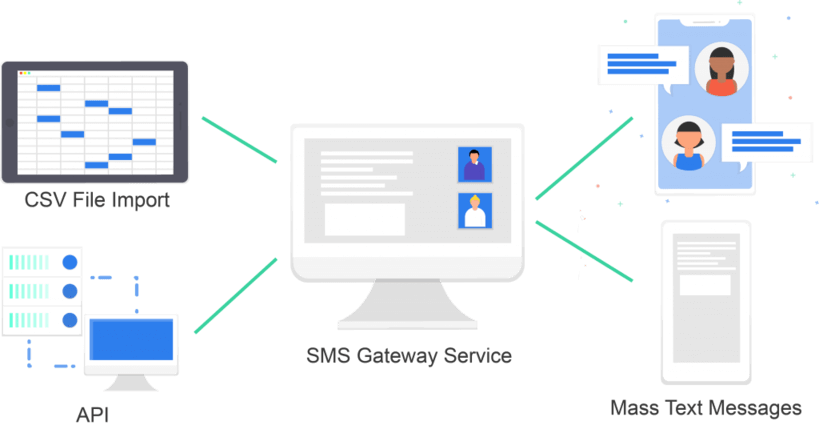
Use our SMS gateway to connect with your favorite backend systems.
Sakari’s messaging API capabilities empower you to easily connect your backend systems. Quickly integrate your current business tools with our RESTful messaging gateway which is built to the latest OpenAPI 3.0 standards.
Award-winning performance
Connect your tech stack with native integrations and flexible API access. Quickly scale communications globally, reduce friction and accelerate every customer’s journey.
Learn MoreFrequently Asked Questions

The Sakari SMS API is a RESTful messaging gateway built to OpenAPI 3.0 standards, which means it follows modern, well-documented conventions that most developers can pick up quickly. To get started, create a Sakari account, then connect your backend system to the API to begin sending and receiving messages programmatically. The OpenAPI specification gives you a clear reference for available endpoints, request formats, and response structures.
Setup is designed to be fast, with most teams able to start sending text messages in less than five minutes. Because the gateway uses standard REST conventions, you can integrate it with virtually any programming language or backend framework. If you'd rather not build a custom integration, Sakari also connects to 1,300+ apps through Zapier and offers native integrations with tools like HubSpot, Pipedrive, and ActiveCampaign for no-code workflows.
The SMS API lets you connect text messaging to your existing backend systems and automate it however your business needs. Core capabilities include sending customized and mass text messages to your contacts, syncing and managing contact data, and managing SMS templates and campaigns programmatically. This makes it possible to trigger texts from your own application logic rather than sending everything manually through a dashboard.
Common use cases include sending order confirmations from an e-commerce backend, dispatching appointment reminders from a booking system, pushing account alerts from an internal tool, and triggering notifications based on events in your database. Anything your system can detect or schedule, the API can turn into an SMS, which is what makes it useful for teams that want messaging embedded directly into their product or operations rather than running as a separate process.
Webhooks let your backend receive real-time notifications when messaging events occur, rather than repeatedly polling the API to check for updates. When an event happens, such as an inbound message arriving or a delivery status changing, Sakari sends an immediate notification to a URL you specify, and your system can act on that data right away.
This is what makes two-way and event-driven messaging practical at scale. Instead of building logic to constantly query for new replies, your application listens for webhook calls and processes inbound messages as they come in. For use cases like automated reply handling, real-time dashboards, or syncing message activity into a CRM or database, webhooks keep your systems current without unnecessary API traffic or delays.
The Sakari SMS API runs on infrastructure built for scale and reliability, with 99.99% uptime backed by redundant data centers and network connections. The redundancy means that if one component has an issue, traffic routes through backup systems so your messaging keeps running. For businesses where SMS is mission-critical, like order notifications or security alerts, this level of uptime matters.
The platform is also built for fast throughput, processing messages quickly so high-volume sends go out without bottlenecks. Whether you're sending a handful of transactional messages or a large campaign to thousands of contacts, the gateway is designed to handle the load and deliver messages promptly. This combination of uptime and throughput is what makes the API suitable for production systems rather than just testing or low-volume use.
Data sent through the Sakari SMS API is encrypted and protected to the latest security standards, both in transit and at rest. All contact data and message content is hosted safely in secure cloud data centers, so you're not responsible for maintaining messaging infrastructure or storage on your own servers.
For developers integrating SMS into a product or internal system, this means the messaging layer comes with enterprise-grade security built in rather than something you have to architect yourself. The cloud-hosted model also means your integration scales automatically as message volume grows, without requiring you to provision additional infrastructure. Combined with the redundant, high-uptime platform, this gives technical teams a messaging foundation they can build on with confidence.
AWARD-WINNING PERFORMANCE